Sound Wave Manipulation Technologies Enhancing Audio Immersion in Open-World Multiplayer Games
Jakob Foster · Aug 30, 2026

Sound Wave Manipulation Technologies Enhancing Audio Immersion in Open-World Multiplayer Games
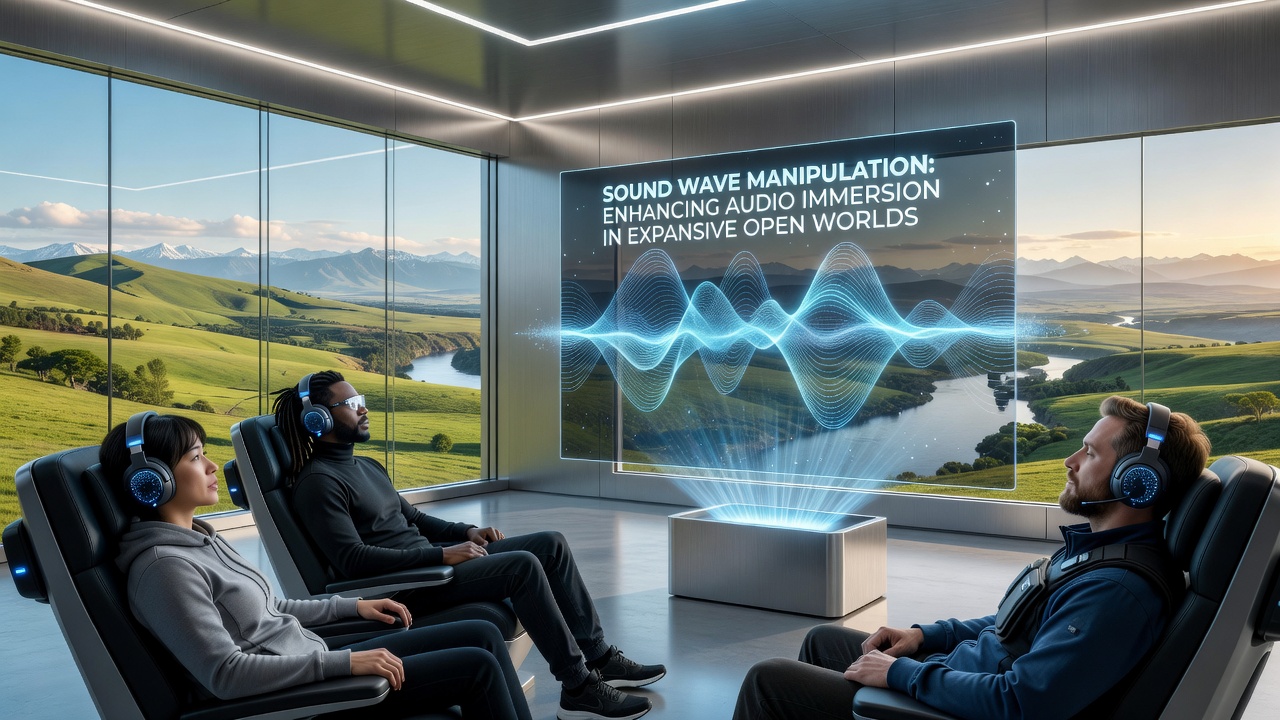
Sound wave manipulation technologies apply digital signal processing and acoustic modeling to shape audio output in real time, allowing expansive open-world multiplayer environments to deliver layered soundscapes that adapt to player positions, actions, and interactions across vast virtual spaces. These systems use wave field synthesis, beamforming arrays, and head-related transfer function adjustments to direct sound energy precisely, while multiplayer servers synchronize audio data streams among thousands of concurrent users without introducing perceptible lag.
Core Mechanisms Behind Wave Manipulation
Developers integrate ultrasonic transducers and phased array speakers into gaming headsets and venue-scale audio rigs, and these components emit controlled interference patterns that construct localized sound sources within a player's perceived space. Data from motion sensors and positional tracking feeds into algorithms that recalculate wave propagation paths every few milliseconds, ensuring that footsteps behind a character register at different amplitudes and phases than distant explosions. Research from institutions in the European Union has documented how such techniques reduce crosstalk between audio channels in shared virtual zones, while studies at Canadian universities have measured improvements in directional accuracy when wave manipulation combines with real-time environmental occlusion mapping.
Multiplayer synchronization protocols transmit compact metadata packets describing sound events rather than full audio waveforms, and receiving clients reconstruct the waves locally using preloaded acoustic models of the game world. This approach keeps bandwidth usage manageable even when hundreds of players trigger simultaneous audio events in the same region.
Implementation in Large-Scale Environments
Open-world titles released or updated through August 2026 incorporate these technologies to handle dynamic weather, vehicle movement, and crowd behaviors that all generate competing sound fields. Engine updates allow servers to prioritize wave calculations based on player density, allocating more processing resources to high-traffic zones where overlapping audio sources could otherwise collapse into muddled noise. Industry reports from Australian game technology associations note that wave manipulation layers have been added to existing spatial audio pipelines without requiring players to purchase new hardware beyond standard USB or wireless headsets supporting 7.1 channel output.
Take one developer team that integrated real-time ray-traced audio alongside wave synthesis, and the combination produced reflections off virtual building surfaces that changed when other players altered the geometry through construction tools or destruction mechanics. Observers note that these reflections maintain phase coherence across multiple listeners because each client applies the same global acoustic simulation parameters downloaded at session start.
Hardware and Software Integration Patterns
Headset manufacturers have begun embedding micro-electromechanical systems that perform on-device wave shaping, and these chips receive instructions from game clients to steer specific frequency bands toward the listener's ears while canceling ambient room reflections. Software development kits released in 2025 included application programming interfaces that let studios define sound emitters as dynamic wave sources rather than static point emitters, and this shift enables audio designers to script behaviors such as sound bending around moving obstacles or focusing into narrow beams during stealth sequences.
Network latency compensation routines predict player trajectories and pre-render anticipated sound wave adjustments, so audio remains continuous even when packet loss occurs. Figures from IEEE technical papers on immersive audio systems indicate that these predictive methods keep perceived desynchronization below the threshold of human detection in sessions involving cross-continental player groups.
Performance Metrics and Observed Outcomes
Testing conducted by independent laboratories shows that players using wave-manipulated audio complete navigation tasks in dense urban maps with fewer errors than those relying on conventional stereo mixes, because directional cues remain distinct amid overlapping gunfire, vehicle engines, and ambient chatter. Data collected during large-scale beta events in mid-2026 revealed that server-side wave aggregation reduced the incidence of audio dropouts when player counts exceeded 150 in a single instance.
Academic papers from research groups in Japan have examined how wave manipulation affects cognitive load during prolonged multiplayer sessions, and results indicate that clearer spatial separation correlates with sustained attention over multi-hour periods. Game analytics platforms now track metrics such as average distance at which players first detect approaching threats, and these numbers have risen in titles that deployed the newer audio pipelines.
Conclusion
Sound wave manipulation continues to evolve through iterative updates that refine synchronization, reduce computational overhead, and expand compatibility with existing consumer hardware. As open-world multiplayer titles grow in scale, the same core techniques that manage thousands of simultaneous sound events today will support even denser player interactions and more intricate environmental acoustics in future releases.